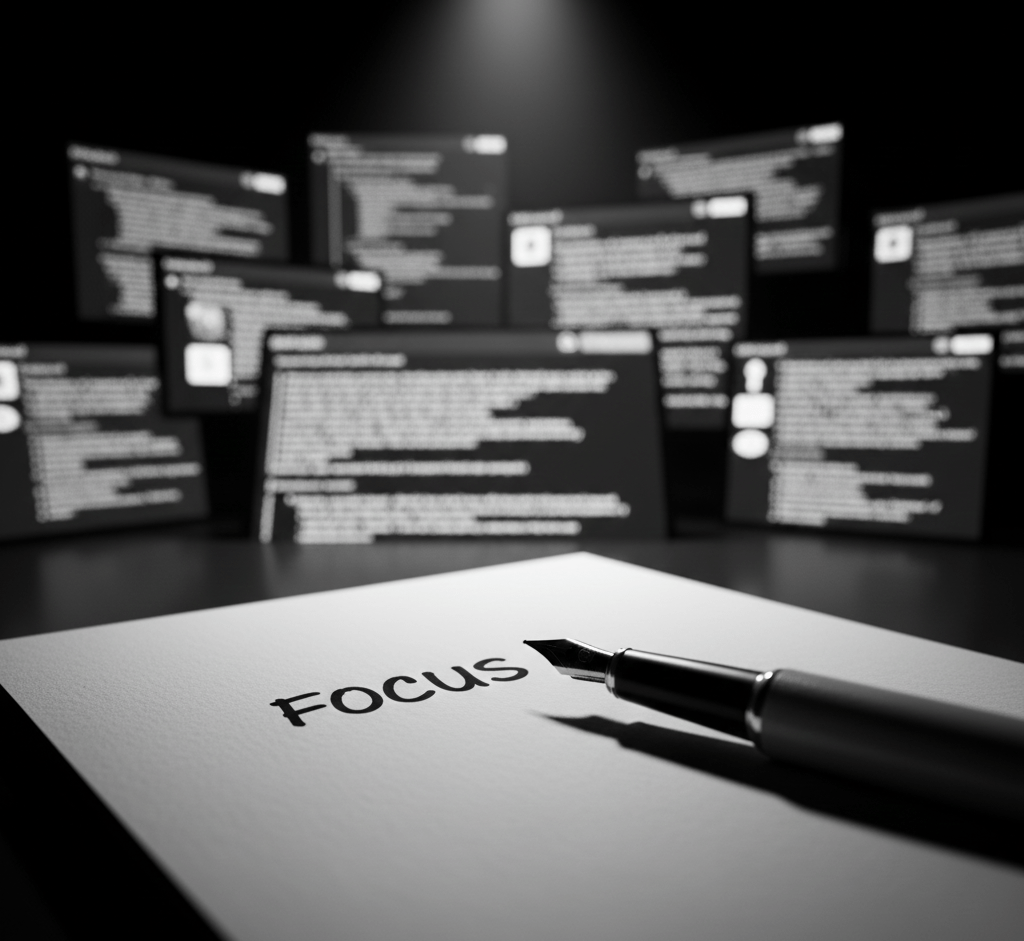
In 2026, the most dangerous employee isn’t the lazy one—it’s the one who is “always busy.”
We’ve inherited a industrial-era obsession with activity. We equate a flooded inbox and a calendar of back-to-back Zoom calls with productivity. But for those of us doing high-level work—the kind that moves the needle on a PhD or a market-shifting strategy—this is a fatal error.
Every time you switch tasks, your brain doesn’t just “jump.” It pays a Cognitive Tax. Scientific literature calls this Attention Residue. When you switch from Task A to Task B, your brain doesn’t immediately follow. A ghost of Task A lingers in your neural pathways, clouding your ability to perform on Task B. If you switch five times an hour, you are essentially functioning with a permanent 10-point drop in your IQ.
“Busy” is often just a sophisticated way of avoiding the hard, solitary work of thinking. It’s a dopamine trap. Checking off ten trivial tasks feels better than struggling with one complex problem for four hours. But at the end of the year, those ten trivial tasks won’t be remembered. The breakthrough will.
Stop bragging about your hustle and start protecting your headspace. If your brain is being strip-mined by notifications, you aren’t a high-performer. You’re just a very efficient processor of noise.
 blogadda
Leave a comment