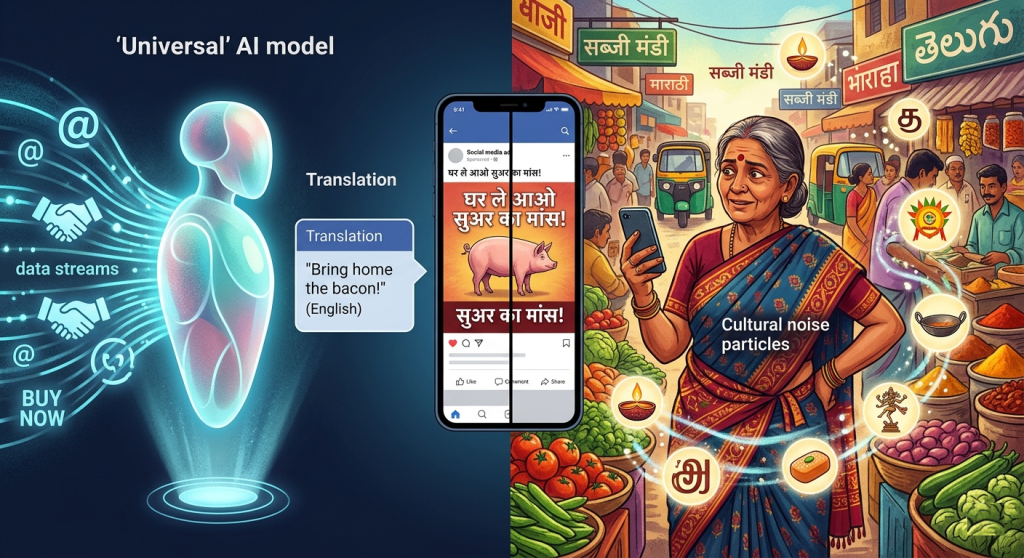
We’ve all seen it: a global brand launches a campaign in India, and the Hindi text looks like it was run through a 2010 version of Google Translate. It’s grammatically “correct,” but it feels… off.
While going through many research papers on the Global AI Divide, I’ve found that the biggest hurdle isn’t language—it’s semiotics. Western AI models are trained on “High-Resource” datasets. They understand the dictionary definition of a word, but they are deaf to its cultural resonance.
The “Bacon” Problem If a Western AI optimizes a “Family Breakfast” campaign, it might default to imagery of eggs and bacon. In the Indian context, that’s not just a mistranslation; it’s a categorical failure. In a country where food is deeply tied to religious and communal identity, a “smart” algorithm that doesn’t understand the nuance of Satvik vs. non-vegetarian options isn’t just inefficient—it’s alienating.
The Trust Deficit When a consumer in a Tier-2 city interacts with an AI-generated ad that uses “Textbook Hindi” instead of the local dialect or “Hinglish,” a “Trust Gap” forms. The consumer realizes, “This brand doesn’t know me; they just translated a message meant for someone else.” To bridge this, we must move toward Deep Localization—where AI learns the context of the street, not just the rules of the grammar book.
 blogadda
Leave a comment