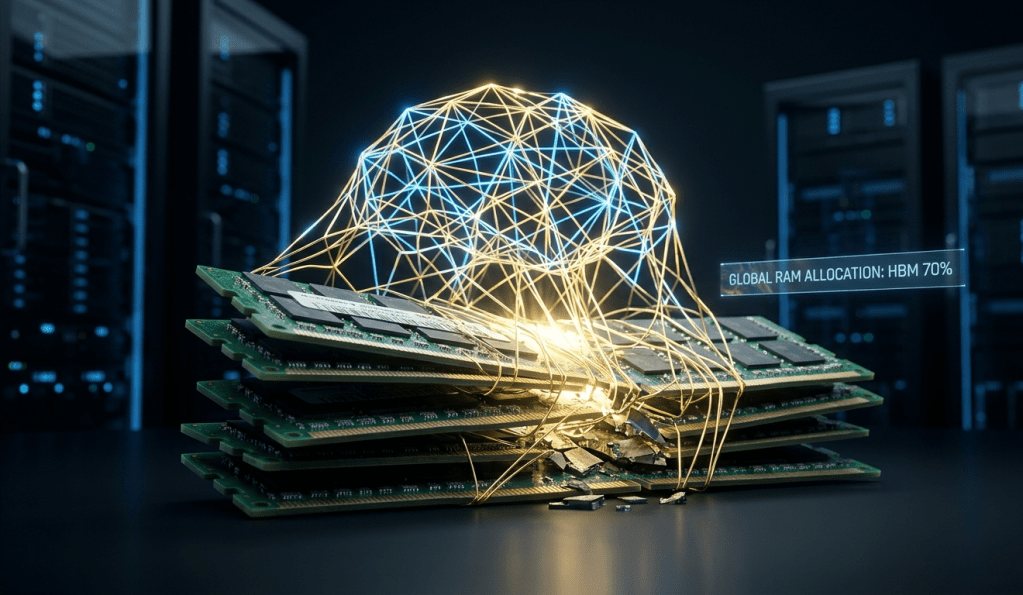
In late 2025, every boardroom was talking about AI software. In 2026, those same boards are realizing they forgot to budget for the hardware. We are no longer in a “shortage”—we are in a Structural Supercycle. If you are trying to scale your digital infrastructure right now, you aren’t just fighting inflation; you are paying an “AI Tax” that is quietly doubling your procurement costs.
The “Cannibalization” of Silicon
The global memory market (DRAM) has hit a tipping point. For years, we relied on a steady supply of DDR4 and DDR5 for our laptops and servers. But the “AI Gold Rush” has changed the math of the factory floor.
Manufacturers like Samsung and SK Hynix are making a cold, hard business calculation: HBM over DDR.
- The Math of Sacrifice: High-Bandwidth Memory (HBM)—the fuel for AI chips—consumes nearly 3x the wafer capacity of standard RAM.
- The Result: Every time a batch of HBM is born to power a data center, the potential for thousands of consumer RAM sticks dies.
- Priority Shift: With HBM profit margins being nearly 10x higher than standard memory, the “allocation” phase has begun. If you aren’t a hyperscaler, you’re at the back of the line.
The 100% Price Jump
The numbers for Q1 2026 are staggering. Consumer RAM prices have surged by over 100%, and Gartner predicts that memory will now account for 23% of the total bill-of-materials (BOM) for a PC—up from just 16% last year.
This isn’t just about “expensive parts.” It’s about the disappearance of the entry-level segment. The sub-$500 laptop is effectively becoming extinct because the “base cost” of just putting 16GB of RAM into a machine has become a luxury.
The Strategic Takeaway
For leaders, the message is clear: Your 2024 procurement playbook is broken.
- Stop waiting for a “dip”: Capacity isn’t coming back until new “Mega-Fabs” go live in 2027 or 2028.
- Audit your lifecycle: The 3-year refresh cycle is now a financial liability.
- Inventory is Strategy: In a supercycle, “Just-in-Time” delivery is a recipe for project failure.
Conclusion: AI is often called “software that thinks,” but in 2026, it is behaving like a physical vacuum, sucking up the world’s silicon and leaving the rest of the enterprise market to pay the bill.
 blogadda
Leave a comment