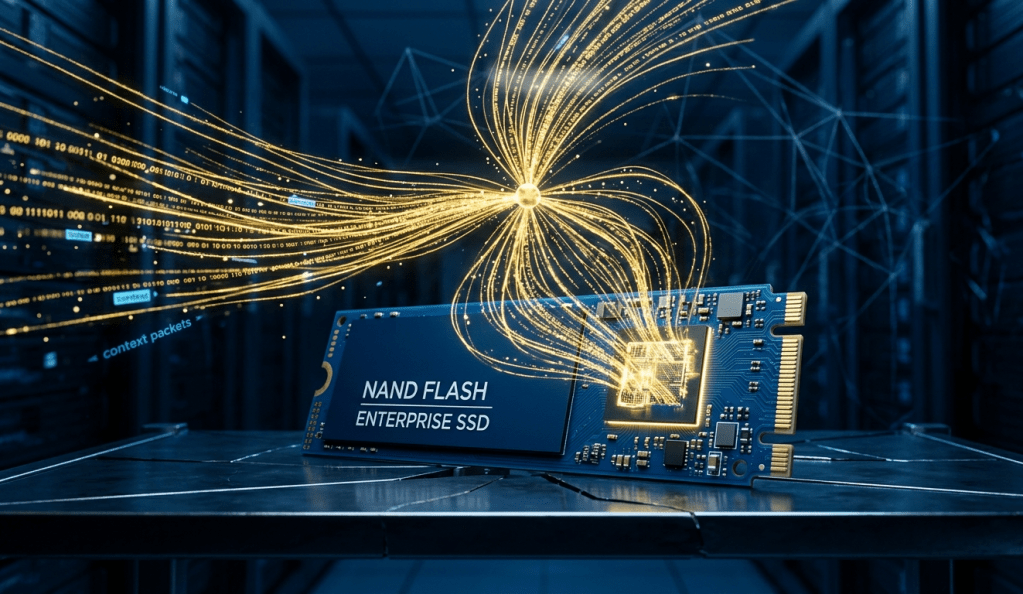
If RAM is the “brain” of the AI revolution, then SSDs (NAND Flash) are its nervous system. And right now, that nervous system is under cardiac arrest.
Data Gravity & the “KV Caching” Reality
AI models, especially Large Language Models (LLMs), don’t just process data once and forget it. They need a continuous “memory” of the context of a conversation. As these conversations get longer and the data gets heavier, a powerful pull—Data Gravity—occurs.
- The Problem: It is too expensive and energy-intensive to store all this heavy context in ultra-fast HBM/RAM.
- The Solution: Hyperscalers are offloading this “medium-term memory” to ultra-high-speed Enterprise SSDs.
- The Result: The rise of KV Caching (storing conversation context) has turned Enterprise SSDs into the most sought-after commodity on earth. Companies are building “All-Flash” data centers because “Just-in-Time” data retrieval is no longer optional for competitive AI.
The “Crumbs” of the Consumer Market
Just as we saw with RAM, this enterprise gold rush leaves the consumer and traditional IT markets with the leftovers. For businesses, this means the high-capacity QLC (Quad-Level Cell) SSDs you were planning to put into your workstations or standard servers are either:
- On allocation (meaning lead times of 3 to 6 months), or
- Selling at a premium of 70%+ higher than 2025 prices.
The narrative that “storage is cheap” is dead. In the age of AI, data has gravity, and that gravity is pulling the world’s highest-performing SSDs into a few select data centers, leaving the rest of the enterprise market paying the price.
The Strategic Takeaway for Leaders
- Validate Inventory: Don’t trust procurement forecasts. Confirm physical inventory before signing off on any major infrastructure project in 2026.
- Rethink Storage Architecure: Your business cannot compete if your on-premise infrastructure is bottlenecked by SATA SSDs. If you can’t afford the enterprise NAND, look at hyper-converged solutions that optimize existing storage.
 blogadda
Leave a comment